

How to Calculate Fabric Yardage Needed: 2026 Guide
Table of Contents
- How to Calculate Fabric Yardage Needed: Step-by-Step
- How to Calculate Fabric for Curtains
- Fabric Pattern Repeat Yardage and Directional Prints
- How Much Fabric for Upholstery Projects
- Using a Fabric Yardage Calculator
- Common Mistakes That Waste Fabric Yardage
- Frequently Asked Questions
Last Updated: October 5, 2026
How to Calculate Fabric Yardage Needed: Step-by-Step
Fabric yardage is the total length of cloth a project requires, measured in yards.
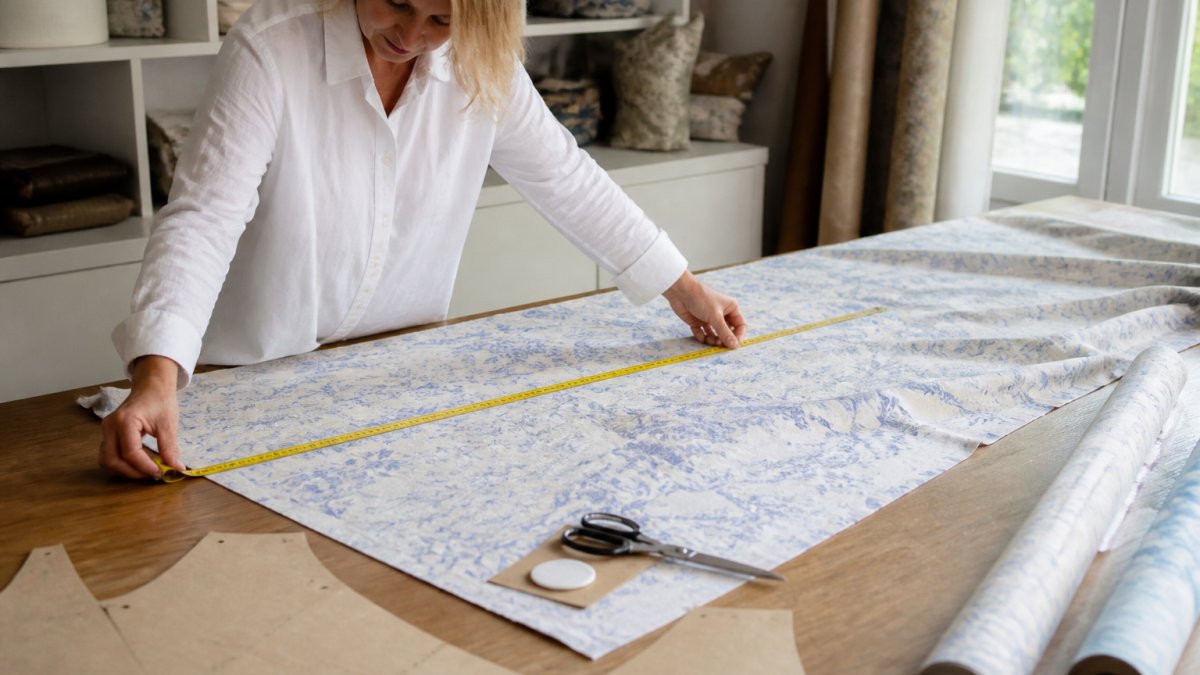
Get it wrong and you either risk a dye-lot mismatch on a reorder or pay for cloth that sits unused.
Step 1: Measure Every Pattern Piece
Start with the pattern envelope, then verify against the actual pieces, suggested ranges assume a specific fabric width and layout, so your size and layout can push the number up.
Measure each piece at its widest point, and write down every piece, including facings, cuffs, collars, and pockets. Small pieces add up fast.
- Measure at the widest point, not the seam line
- Include every facing, lining, and interfacing piece
- Note the grain line direction on each piece
A common mistake is skipping the interfacing and lining yardage. Those are separate purchases with their own widths.
Step 2: Convert Inches to Yards (Divide by 36)
One yard equals 36 inches, so divide your total inches by 36. If your pattern pieces need 90 inches of length, that is 2.5 yards.
Work in inches first, then convert at the end. Mixing units mid-calculation is where errors creep in.
- 36 inches = 1 yard
- 45 inches = 1.25 yards
- 54 inches = 1.5 yards
Round up to the nearest quarter yard when you buy, it is easier to order and gives you a small safety margin.
Step 3: Factor in Fabric Width and Usable Width
Fabric width changes everything: a pattern needing 3 yards of 60-inch fabric may need 4.5 yards of 45-inch fabric. Check the width your pattern assumes before you buy.
Usable width is narrower than listed width, selvedges, printed borders, and damaged edges eat into what you can cut. On a 54-inch bolt, expect roughly 50 to 52 inches of usable width.
| Listed Width | Typical Usable Width | Best For |
|---|---|---|
| 45 inches | 42-43 inches | Apparel, small home decor |
| 54 inches | 50-52 inches | Upholstery, drapery, bedding |
| 60 inches | 56-58 inches | Wide drapery, large upholstery |
| 108 inches | 104-106 inches | Seamless tablecloths, wide curtains |
How to Calculate Fabric for Curtains
Curtain yardage depends on finished width, not window width. Multiply window width by 2 to 2.5 for fullness, then divide by fabric width for panel count.
Here is the working method:
- Measure window width and desired finished length
- Multiply width by 2 for standard fullness, 2.5 for a fuller look
- Divide that total by usable fabric width to get panel count
- Add 8 inches per panel for hems and header
- Multiply panel length by panel count, then convert to yards
For a 60-inch window with 2x fullness, you need 120 inches of finished width, three panels on 54-inch fabric. At 90 inches long plus 8 inches of hem allowance, that is 98 inches per panel, or 294 inches total: 8.2 yards, rounded up to 8.5.
Fabric Pattern Repeat Yardage and Directional Prints
Pattern repeat yardage is the extra length you add so motifs line up across seams, a cut-length calculation worth doing by hand once.
Find the repeat size and the match type
The repeat is printed on the bolt or spec sheet in three forms, each changing the math:
- Straight repeat (horizontal match): motifs line up side by side at the same height. This is the easiest to match and wastes the least.
- Half-drop repeat: every other column of motifs is offset by half the repeat height. Common in large florals and damasks. It forces you to add more length because adjacent panels cannot start at the same point.
- Brick or offset repeat: motifs stagger by a fixed fraction of the repeat. Treat it like a half-drop for estimating purposes.
If the bolt does not state the match type, lay two cut lengths side by side and slide one until the motifs align, the distance moved is your offset.
Calculate cut length per panel
Do not estimate panel length from finished length alone. Use this sequence:
- Start with the finished length you want (for example, a 90-inch curtain panel).
- Add the hem and header allowance (commonly 8 inches total, but check your pattern).
- That gives your minimum cut length, 98 inches in this example.
- Divide the minimum cut length by the repeat size. Round up to the next whole number.
- Multiply that whole number by the repeat size to get the adjusted cut length.
Worked example with a 24-inch repeat:
- Minimum cut length: 98 inches
- 98 ÷ 24 = 4.08 → round up to 5
- 5 × 24 = 120 inches adjusted cut length
That panel grew from 98 to 120 inches, 22 inches spent on matching, or about 2.5 yards across four panels.
Add the offset for half-drop and brick repeats
For a half-drop repeat, add half the repeat size to the adjusted cut length of every panel after the first. With a 24-inch repeat, the offset is 12 inches, so panels two through four each start at 132 inches instead of 120, another 36 inches across three panels.
Directional prints and nap
A one-way print, stripe, plaid, or nap fabric such as velvet or corduroy cannot be rotated 180 degrees to save space, every piece must face the same direction. On a pattern with many small pieces, that constraint alone can push yardage up by a fifth or more.
- Check the bolt for a directional arrow or the words "with nap" or "one-way design."
- Assume every piece faces the same way unless the fabric is a solid or a true reversible print.
- For plaids, add one full repeat per panel and plan to match at the side seams, not just the top and bottom.
When to buy the extra yard
If the fabric is a closeout, limited dye lot, or special order, buy one extra repeat beyond your calculated total, a spare yard costs less than a reorder that does not match.
How Much Fabric for Upholstery Projects
Upholstery is the hardest category to estimate because furniture shapes are irregular and most pieces are cut from panels larger than a single pattern piece. The ranges below are starting points; the method underneath gets you to an orderable number.
Starting ranges for common pieces
These assume 54-inch-wide upholstery fabric, a solid or small-scale print, and no large pattern matching:
- Dining chair seat only: 1 to 1.5 yards
- Dining chair with back and seat: 2 to 3 yards
- Armchair (no skirt): 6 to 8 yards
Add 15 percent for a large print or plaid that must be matched, and another 10 percent for seam allowances, piping, and cutting errors. Never skip the safety margin.
Measure the piece in sections, not as a whole
Do not estimate the whole sofa at once. Break it into the panels an upholsterer would cut, and measure each at its widest point:
- Seat cushions: measure the top face, the front face, and the two side faces separately. A box cushion is four rectangles plus a zipper panel.
- Back cushions: same approach, plus any welt or piping.
- Inside back and inside arms: measure the visible face and add the wrap-around allowance where the fabric tucks into the frame.
Convert panel measurements to yardage
Once you have the panel list, the conversion uses the same width-and-length logic as apparel:
- Group panels by the fabric width they will be cut from (usually the full 54 inches minus 2 to 4 inches of usable width).
- For each group, lay the panels out side by side in your head or on paper. Count how many rows you need.
- Multiply the number of rows by the tallest panel in each row. That is your cut length for that group.
- Add the groups together, add your seam and matching allowance, then divide by 36.
A worked example: a wingback chair with a 30-inch outside back, 26-inch inside back, two 24-inch arms, and a 22-inch seat cushion. If the outside back and one arm fit across the width in one row, the inside back and other arm in a second, and the cushion in a third, you have three rows. The tallest panel is 30 inches, so three rows at 30 inches is 90 inches, or 2.5 yards, before seam allowances, piping, and matching.
Piping, welt, and bias trim
Piping and welt cord are cut on the bias, so they consume more fabric than their finished length suggests. A common rule is one yard of 54-inch fabric for every 12 to 15 yards of finished piping, because bias strips cut from a square waste the corners.
When to call in a professional
If the piece has curved arms, a tight camelback, or a tufted back, the panel count is hard to predict from measurements alone. An upholsterer who has done the same frame can give you a number in minutes.
Using a Fabric Yardage Calculator
A fabric yardage calculator speeds up the math, but only if your inputs are right. Most ask for project type, dimensions, fabric width, and pattern repeat, feed it wrong numbers and you get a confident wrong answer.
Use a calculator for:
- Quick estimates before you commit to a design
- Comparing yardage across two fabric widths
- Checking your manual math
Do the layout check by hand anyway, software does not know your fabric has a directional print or a damaged selvedge.
At Designer Fabrics USA, our team can walk through your measurements and confirm the yardage before you order.
Common Mistakes That Waste Fabric Yardage
The biggest yardage mistakes come from skipping width, repeat, and allowance checks, each easy to fix.
| Mistake | Fix | Impact |
|---|---|---|
| Using listed width, not usable width | Subtract 2-4 inches for selvedge | Avoids short cuts |
| Forgetting seam allowances | Add 5/8 inch per seam | Prevents tight pieces |
| Skipping pattern repeat | Add one repeat per panel | Keeps motifs aligned |
| Ignoring directional prints | Assume all pieces face one way | Prevents wasted fabric |
| Not prewashing | Wash and dry before cutting | Stops post-sew shrinkage |
Prewashing matters more than most guides admit. Natural fibers like cotton and linen can shrink after the first wash. If you cut before washing, your finished piece may not fit. Wash and dry the fabric the same way you will care for the finished item.
For a deeper look at how shrinkage and fiber content affect yardage, the American Society for Testing and Materials textile standards publishes reference methods for fabric testing. The Federal Trade Commission's textile labeling rules also explain what fiber and care information must appear on the bolt.
Frequently Asked Questions
What is the formula for calculating fabric yardage?
Measure each pattern piece in inches, multiply length by width to get square inches, then total all pieces. Divide the total by the fabric's usable width in inches to find the length needed. Finally, divide that length by 36 to convert to yards. Always add 10-15% extra for seam allowances, hems, and cutting errors before rounding up to the nearest quarter yard.
How much extra fabric should I buy for pattern matching?
For directional prints or large repeats, add one full pattern repeat per cut piece. If the repeat is 12 inches and you are cutting four pieces, add 48 inches (1.33 yards) to your total. For small repeats under 6 inches, adding 10-15% to your yardage estimate is usually sufficient. Always round up rather than risk running short mid-project.
How does fabric width affect the yardage I need?
Fabric width determines how many pattern pieces fit side by side. A 44-inch-wide fabric may fit two pieces across, while a 60-inch width might fit three. Wider fabric often reduces total yardage because you waste less on the sides. Always check the usable width after selvages, which typically removes 1-2 inches from each side.
How many yards of fabric do I need for a 3-seater sofa?
A standard 3-seater sofa typically requires 14 to 18 yards of 54-inch-wide upholstery fabric. This range covers the frame, cushions, and arms. If your fabric has a large pattern repeat or you are reupholstering a sectional, add 15-20% more. Measure each section separately and total the fabric yardage before ordering.
Fabric math rewards patience, and a short order can stall a project for weeks while you wait on a matching dye lot. Designer Fabrics USA carries a deep selection of premium designer fabrics, wallpapers, and trimmings, with free shipping across the country and a custom quote service for hard-to-find items. Our team offers personalized sourcing help, so you can confirm yardage and fabric choice before you commit. Shop now and start your next project with fabric you can trust.